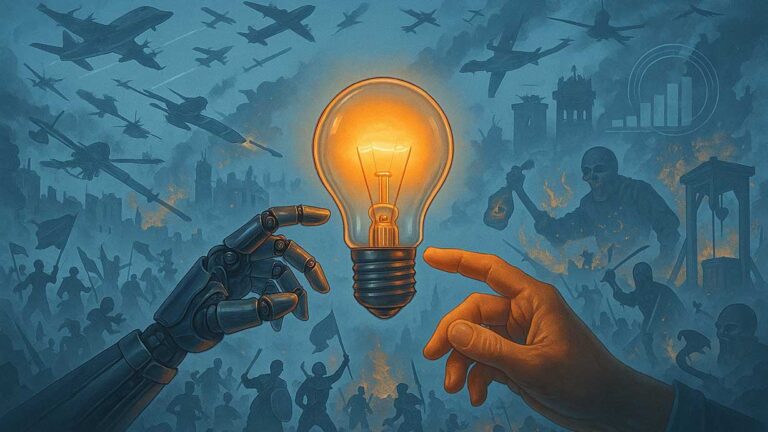
Call for Papers (Vol. 2, Issue 1) on the theme "Artificial Intelligence and Emerging Technologies: Power, Governance, and the Changing Global Order"
About the issue:
Artificial intelligence and emerging technologies are rapidly reshaping the structures of power, governance, security, economy, and social life across national, regional, and global domains. No longer confined to the realm of technical innovation, these technologies increasingly function as political, strategic, and normative instruments that influence state capacity, geopolitical competition, economic dependency, public decision-making, and societal transformation.
This issue invites critical, theoretical, and policy-oriented contributions that examine how artificial intelligence and emerging technologies are reconfiguring authority, accountability, sovereignty, justice, and global governance in the twenty-first century. It seeks to explore the evolving relationship between technological systems and political power, with particular attention to questions of digital sovereignty, algorithmic governance, platform power, cybersecurity, surveillance, military innovation, technological dependency, and the unequal distribution of technological capabilities across the international system.
The issue especially encourages contributions from Global South perspectives, comparative and interdisciplinary approaches, and analyses that bridge international relations, public policy, political economy, security studies, governance studies, law, ethics, sociology, and critical technology studies.
By bringing together diverse scholarly voices, this issue aims to foster a nuanced understanding of technology not as an autonomous or inevitable force, but as a domain shaped by political choices, institutional arrangements, strategic interests, and competing societal values.
Contributions may engage with any of the following sub-themes:
- Digital Sovereignty: Examines the efforts of states and regions to assert autonomous control over their digital infrastructures, data flows, and technological ecosystems in the face of platform dominance and foreign technological dependency.
- AI Governance: Explores the emerging frameworks, institutions, and regulatory mechanisms — at national, regional, and international levels — through which artificial intelligence is being governed, standardised, and ethically constrained.
- Cyber Geopolitics: Analyses how cyberspace has become a central theatre of geopolitical rivalry, encompassing state-sponsored cyber operations, critical infrastructure vulnerabilities, and the strategic competition over internet governance norms.
- Platform Capitalism: Investigates the political and economic power of large digital platforms, their roles in shaping labour markets, public discourse, and regulatory environments, and the implications of platform monopolisation for democratic governance.
- Technological Nationalism: Considers how states are increasingly deploying technology policy as an instrument of national identity, economic protectionism, and strategic competition, including through industrial subsidies, export controls, and domestic technology mandates.
- Data Colonialism: Critically examines the asymmetrical extraction and commercial exploitation of data from populations in the Global South by corporations and states in the Global North, drawing parallels with historical structures of colonial resource extraction.
- Algorithmic Governance: Studies how automated decision-making systems are increasingly deployed in public administration, policing, welfare distribution, and border control — raising fundamental questions of accountability, transparency, bias, and legitimacy.
- Military Applications of AI: Addresses the integration of artificial intelligence into defence systems, autonomous weapons platforms, intelligence operations, and military decision-making, alongside the emerging legal and ethical frameworks governing lethal automation.
- Labour and Technological Change: Examines the transformative impact of automation, AI, and digitalisation on labour markets, work conditions, and employment structures — with particular attention to inequality, informality, and the political economy of technological displacement.
- Technology and Future International Orders: Explores how the uneven distribution of technological capabilities is shaping emerging configurations of global power, multilateral governance, and international order — including debates on multipolarity, technological hegemony, and post-Western futures.
Important Dates:
- Full manuscript deadline: 10th July 2026
All deadlines are at 23:59 (IST). Authors are encouraged to submit abstracts well in advance of the deadline. Submissions received after the closing date may not be considered for this issue.
Manuscript Submission: Authors may submit their abstracts and full manuscripts electronically via Email: contacteditor@techadetheejournal.com
For editorial queries, submission-related communication, and correspondence, authors are requested to contact the editorial office through the above email address only.
Submission Guidelines: All manuscripts submitted to this issue must adhere to the following guidelines. Submissions that do not conform to these requirements may be returned to authors without review.
- Abstract: 150–250 words, structured as: background, argument, methodology (if applicable), and contribution
- Keywords: 5 to 7 keywords reflecting the core themes of the manuscript
- Font and spacing: Times New Roman, 12pt, double-spaced throughout
- Margins: 1 inch (2.54 cm) on all sides
- Citation style: Chicago Author-Date (17th edition) for in-text citations and references
- File format: Microsoft Word (.docx); PDFs are not accepted at the initial submission stage
- Anonymisation: All identifying information must be removed from the manuscript file; author details are to be submitted separately via the author information form
- Figures and tables: Embedded within the text at the point of reference; high-resolution versions (300 dpi minimum) to be provided separately upon acceptance
- Footnotes: Used sparingly and for substantive commentary only; not for bibliographic references
Types of Contributions: This issue welcomes contributions across a range of scholarly formats. Authors are invited to select the format most appropriate to their argument, evidence, and intended contribution to the field.
- Original research article: 6,000 – 9,000 words. Empirically grounded or theoretically sustained arguments making an original contribution to the field, inclusive of references
- Policy analysis: 4,000 – 6,000 words. Rigorous analyses of specific policy frameworks, regulatory mechanisms, or governance instruments, with clear implications for scholarship or practice
- Critical commentary: 2,500 – 4,000 words. Focused and well-argued responses to recent developments, debates, or publications of significance to the field
- Book review: 1, 000 – 2,000 words. Critical reviews of recent scholarly works relevant to the themes of the issue; review essays covering two or more related works are also welcome
- Note: All word counts are inclusive of references and footnotes. Interdisciplinary submissions that do not fit neatly within any single format are strongly encouraged; authors are welcome to contact the editors in advance to discuss the suitability of their proposed contribution.
Publication Ethics Statement
Techade: An International e-Journal on Emerging Technologies and Power Dynamics upholds the highest standards of publication ethics and is committed to the principles established by the Committee on Publication Ethics (COPE). All editors, reviewers, and authors are expected to adhere to these standards throughout the submission, review, and publication process.
- Originality and Plagiarism: Manuscripts submitted to Techade: An International e-Journal on Emerging Technologies and Power Dynamics must represent original, unpublished work. Any form of plagiarism — including the unattributed reproduction of text, data, ideas, or visual material from other sources — is considered a serious ethical breach and will result in immediate rejection. All submissions may be screened using plagiarism detection software prior to review.
- Simultaneous Submission: Manuscripts submitted to the journal must not be simultaneously under consideration at any other publication. Authors must confirm at the point of submission that the manuscript is not currently under review elsewhere and has not been previously published in any form, including as a working paper, conference proceedings, or preprint, without prior disclosure to the editorial team.
- Authorship and Contribution: All named authors must have made a substantive intellectual contribution to the work. The corresponding author is responsible for ensuring that all co-authors have approved the final version of the manuscript and have consented to its submission. Any changes to authorship following submission must be communicated to and approved by the editorial team.
- Conflicts of Interest: Authors must disclose any financial, institutional, or personal relationships that could be perceived as influencing the research or its interpretation. Reviewers who identify a conflict of interest with a submitted manuscript are expected to notify the editorial team and recuse themselves from the review process.
- Research Ethics: Where applicable, authors must confirm that research involving human subjects has been conducted in accordance with applicable ethical guidelines and has received approval from a relevant institutional review body. Authors must indicate whether informed consent was obtained from research participants.
Open Access and Copyright Policy: Techade: An International e-Journal on Emerging Technologies and Power Dynamics is committed to the widest possible dissemination of high-quality scholarship and operates under a gold open access model. All published articles are made freely available online immediately upon publication, without embargo, and without subscription or access fees for readers.
Article Processing Charge (APC): At present, Techade: An International e-Journal on Emerging Technologies and Power Dynamics does not charge any Article Processing Charges (APCs) for manuscript submission, processing, review, or publication. Authors are not required to pay any fee at any stage of the editorial or publication process. The journal is committed to promoting accessible and equitable academic publishing, particularly for early-career researchers and scholars from underrepresented institutions and regions.
Licence: All articles published in Techade: An International e-Journal on Emerging Technologies and Power Dynamics are licensed under the Creative Commons Attribution 4.0 International Licence (CC BY 4.0), which permits unrestricted use, distribution, and reproduction in any medium, provided the original work is properly cited.
Author Rights: Authors retain copyright of their published work. Authors are permitted to self-archive accepted manuscripts on personal or institutional repositories and to share their work through academic networking platforms in accordance with the journal’s self-archiving policy. Published versions may also be deposited in open-access repositories immediately upon publication.
Editor’s Note
We live at a moment when the question of technology is no longer separable from the question of power. Artificial intelligence, digital infrastructure, and emerging technological systems are quietly — and sometimes not so quietly — reshaping the boundaries of sovereignty, the structures of governance, and the conditions of everyday political life across the world. The challenge for the social sciences and humanities is not simply to observe this transformation, but to think carefully and critically about it: to ask not only what technology can do, but whose interests it serves, whose voices it silences, and what futures it forecloses.
This issue of Techade: An International e-Journal on Emerging Technologies and Power Dynamics was conceived in response to what we see as an urgent gap in the existing literature. The dominant conversations surrounding artificial intelligence and emerging technologies continue to be shaped overwhelmingly by perspectives emerging from a small number of technologically advanced states and institutions. The concerns of the Global South — from digital dependency and data colonialism to regulatory exclusion and asymmetric access — remain insufficiently theorised and systematically marginalised in mainstream academic and policy discourse. We believe this imbalance requires serious scholarly attention.
With this issue, Techade: An International e-Journal on Emerging Technologies and Power Dynamics seeks to create a space for rigorous, diverse, and genuinely global scholarship on technology, governance, and power. We are particularly interested in contributions that challenge established analytical frameworks, introduce underrepresented empirical contexts, or bring new theoretical perspectives to contemporary technological debates. The journal welcomes interdisciplinary engagement across political science, international relations, public policy, law, sociology, media studies, philosophy, and related fields.
We are equally eager to receive contributions from senior scholars, policy practitioners, doctoral researchers, and early-career academics whose work advances critical and original thinking in this rapidly evolving area of study.
We warmly invite you to be part of this conversation.


Note: Techade is an open-access e-journal that involves no publishing or processing fees
© 2026 Techade Publications. All rights reserved.
Publisher: Techade Publications,
Bilaspur – 495009, Chhattisgarh, India
Editorial Office: Department of Political Science,
Guru Ghasidas Vishwavidyalaya Koni, Bilaspur – 495009, Chhattisgarh, India
- contacteditor@techadetheejournal.com
- Techade An International e-Journal
- Techade E Journal
- @tech_ade